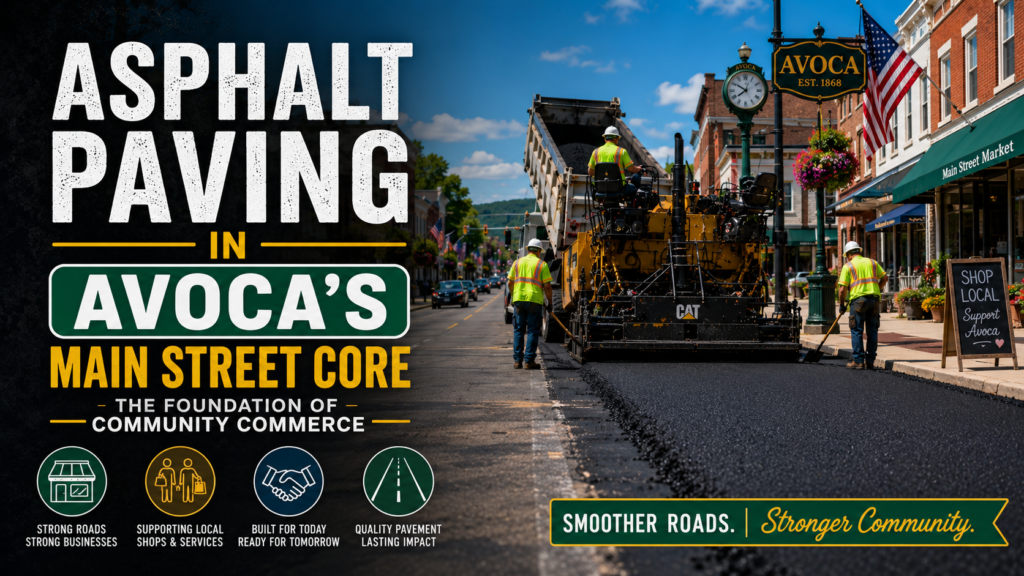
Every small borough in Pennsylvania has a Main Street and that street is more than just a thoroughfare. It is the center of commercial and civic life, the place where residents come to shop, dine, pick up their mail, and interact with their neighbors. In Avoca, the Main Street core is the heartbeat of the borough, home to the post office (which has served the community since the borough’s earliest days on Main Street), local businesses, and the kind of ground-level activity that makes a small town feel alive.
From a pavement perspective, Main Street and its immediate surroundings represent one of the most demanding environments for asphalt in any community. Commercial vehicle deliveries, commuter traffic, pedestrian zones, parking lanes, and private driveway connections all converge in a compact area, and the asphalt surfaces that serve these uses are under constant stress. Understanding how Asphalt Contractor Main Street Core is designed, constructed, and maintained for these high-demand conditions illuminates what it takes to keep a community’s commercial core functioning smoothly.
What Makes Commercial Core Paving Different
The pavement demands of a commercial main street corridor are substantially different from those of a residential side street. Several factors distinguish the Main Street core environment:
Traffic Volume and Composition: A Main Street handles orders of magnitude more vehicle passes than a typical residential driveway or side street. Moreover, the vehicle mix includes delivery trucks, service vehicles, and buses alongside personal automobiles a range of axle weights and tire types that collectively apply far more stress to pavement than residential traffic alone.
Turn and Stop Cycles: Unlike through-traffic that maintains speed and applies primarily vertical load to pavement, commercial corridor traffic involves frequent stopping, turning, and idling. These movements apply horizontal shear forces to the pavement surface that accelerate rutting, particularly in summer heat when asphalt binder softens.
Pedestrian Interface: In many main street configurations, paved areas transition from vehicle lanes to parallel parking to sidewalks in a compressed cross-section. These transitions curbs, drainage inlets, sidewalk aprons are stress concentration points that require careful design and construction.
Utility Interference: Main Street corridors are typically home to dense underground utility infrastructure water, sewer, gas, electric, telecommunications. Utility trenches cut through pavement for maintenance are common, and each trench repair must be properly constructed to avoid becoming a persistent weak point in the pavement.
Loading Zones and Heavy Vehicle Access: Commercial deliveries require access to loading zones where heavy trucks park with full or partially loaded axles. These point loads must be accounted for in pavement design.
Pavement Materials for Commercial Environments
To meet the demands of a busy commercial corridor, pavement designers and contractors specify materials that go beyond standard residential mix designs:
Superpave High-Traffic Surface Mixes: These surface course mixes use coarser aggregate, stiffer binders, and tighter gradation controls to maximize resistance to rutting and fatigue. The Superpave volumetric mix design protocol includes compaction requirements calibrated to the expected traffic level mixes designed for high-traffic commercial areas use more compactive effort in the laboratory to simulate real-world densification.
Polymer-Modified Binders (PMBs): Standard asphalt binders are viscoelastic they flow under sustained load, particularly at elevated temperatures. Polymer modification, typically using styrene-butadiene-styrene (SBS) or ethylene-terpolymer elastomers, dramatically improves the binder’s resistance to high-temperature deformation (rutting) while maintaining low-temperature flexibility (crack resistance). PMBs are standard specification for high-traffic commercial pavements in Pennsylvania.
Stone Matrix Asphalt (SMA): A gap-graded mix with high coarse aggregate content and a rich binder. The aggregate skeleton in SMA carries load through stone-to-stone contact, with the high-binder fraction filling the voids and providing durability. SMA provides superior rutting resistance in heavy-traffic applications and is increasingly used on commercial streets and parking areas.
Open-Graded Friction Courses (OGFC): Used on some commercial streets as a surface treatment for noise reduction and wet-weather friction improvement, OGFC mixes have high void contents that allow water to drain through the surface quickly, reducing splash and hydroplaning risk.
Parking Lot Design Principles for Commercial Areas
Commercial properties along and near Main Street almost universally need associated parking either on-street (managed by the borough) or off-street (private lots). Well-designed commercial parking lots consider several factors beyond simply paving a flat area:
Traffic Circulation Pattern: Parking lots should have clearly defined entry and exit points, defined drive aisles, and a logical circulation pattern that minimizes vehicle conflicts. One-way aisles are often more efficient and safer than two-way configurations in compact lots.
Stall Dimensions: Standard parking stall dimensions (typically 8.5–9 feet wide by 18 feet deep) must be maintained for safe parking and vehicle maneuvering. Angled parking (45° or 60°) can increase stall count in some configurations but affects aisle width requirements.
Drive Aisle Widths: Minimum drive aisle widths depend on parking angle 90° (perpendicular) parking requires the widest aisles (typically 24 feet for two-way traffic); angled parking can use narrower aisles.
ADA Accessible Spaces: Federal law requires a specific ratio of accessible parking spaces based on total lot capacity, with precise dimensions for stalls and access aisles. Van-accessible spaces require a minimum 8-foot access aisle beside an 8-foot stall, for a total of 16 feet. Accessible spaces must be located on the most accessible route to the building entrance.
Drainage Design: Parking lots must drain toward designated collection points. Flat or improperly graded lots that allow ponding create asphalt deterioration, icing hazards in winter, and pedestrian safety issues.
Light and Visibility: Though not directly a paving issue, the pavement design must accommodate light pole bases and electrical conduit runs both of which affect pavement structure at their locations.
Utility Cuts and Pavement Restoration: A Common Challenge
One of the persistent pavement challenges in any established commercial corridor is the utility cut sections of pavement that have been excavated for utility work and subsequently restored. Poor utility cut restoration is one of the most common causes of premature pavement deterioration in commercial areas.
Why Utility Cuts Create Problems:
Settlement: Utility trench backfill, no matter how carefully placed, typically settles over time particularly under traffic. Settlement creates depressions that collect water and create ride quality problems.
Interface Cracking: The boundary between a utility cut restoration and the surrounding pavement is inherently a joint a potential weakness. If the restoration pavement is not properly keyed into the surrounding pavement and the joint is not sealed, water infiltration along the joint accelerates deterioration.
Inconsistent Compaction: Achieving proper compaction in a narrow trench is challenging, particularly near utility pipes and conduits that cannot be disturbed. Inadequate trench compaction leads to settlement and structural weakness.
Best Practices for Utility Cut Restoration:
- Saw-cut rather than break the pavement at the trench perimeter to create clean, vertical edges
- Compact backfill in maximum 6-inch lifts using appropriate compaction equipment
- Match the restored pavement thickness to the surrounding pavement structure (base and surface courses)
- Apply tack coat to the cut edges before placing new pavement
- Seal the joint between new and existing pavement with hot-pour crack sealant after the restoration has cured
- Consider a wider surface patching area (beyond the actual trench width) to encompass any edge disturbance
Many municipalities require contractors performing utility work to adhere to specific pavement restoration standards, and some require that restored cuts be resurfaced to the full lane width to minimize joint cracking. Contractors familiar with local standards can ensure restorations meet those requirements.
Seasonal Maintenance in the Commercial Core
Commercial core pavement requires more frequent and proactive maintenance than residential surfaces, simply because the consequences of deterioration are more immediate affecting customer access, business operations, and the image the community presents to visitors.
Pre-Winter Preparation: Before the first freeze, crack sealing is the most important maintenance activity. Any open cracks must be sealed to prevent water infiltration and freeze-thaw damage during winter. Sealcoating should be completed in fall if due, to provide maximum protection through winter.
Post-Winter Assessment: Spring thaw is the best time to assess winter damage and plan needed repairs. Pothole patching should be completed as soon as practical after weather permits proper hot-mix repairs.
Summer Maintenance: Summer is peak season for resurfacing and overlay projects, when temperatures support quality hot-mix placement and curing. Sealcoating is best performed in warm, dry weather.
Ongoing Inspections: A regular walking inspection of commercial parking areas and driveways at least twice a year allows early identification of developing problems before they become major repairs.
Asphalt’s Role in Commercial Property Value
Well-maintained asphalt pavement in a commercial setting is not a passive amenity it actively contributes to property value and business success. Research in commercial real estate consistently shows that:
First Impressions Matter: The first thing a potential customer, tenant, or buyer sees when approaching a commercial property is often the parking area and driveway. A smooth, freshly sealed, well-marked lot communicates professionalism and care. A cracked, faded, potholed lot communicates neglect.
Safety and Liability: Cracked pavement, potholes, and uneven surfaces are documented causes of vehicle damage and pedestrian injuries. Property owners are potentially liable for injuries resulting from known pavement hazards that were not addressed.
Tenant Retention and Attraction: Commercial tenants particularly retail and service businesses that depend on customer traffic are sensitive to the quality of parking and access infrastructure. Properties with well-maintained exterior environments command higher rents and experience lower vacancy.
Regulatory Compliance: Poorly maintained parking lots may fail municipal code inspections and require costly emergency remediation if violations are cited.
Conclusion: Main Street Deserves the Best
Avoca’s Main Street core is more than a commercial district it is the living center of a community with over 150 years of history. The pavement that serves it must be equal to the task: durable enough to withstand heavy commercial traffic, well-designed to manage drainage and pedestrian interfaces, properly maintained to remain safe and attractive, and informed by the science of modern asphalt engineering.
From the selection of polymer-modified binders to the careful compaction of surface courses, from the design of accessible parking to the proper restoration of utility cuts, quality asphalt work in a commercial core requires the full application of professional knowledge and skill. When that work is done right, it supports the economic vitality and community pride that makes Main Street matter,